Cloud-Based Software Solutions for Modern Businesses
January 07, 2026 • Noor Ul Sabah
Introduction
The world is dynamic, and companies need to look at using cloud-based software that can enhance efficiency, scalability, and collaboration. Cloud solutions are not installed on local machines in the same way as traditional software; instead, they are stored on remote servers and accessed through the internet. It allows the teams to operate wherever they are and get real-time data.
Small and large organizations, modern businesses, are using cloud-based software to cut down on expenses, streamline their processes, and stay competitive. This article provides a comprehensive review of the main advantages, categories, best practices, and difficulties of cloud adoption with the aim of giving a full guide to businesses that intend to adopt cloud technology.
What is Cloud-Based Software?
Cloud-based software runs on remote servers instead of local computers. Users access these applications over the internet, usually via a browser or special app. This model eliminates the requirement for businesses to maintain expensive infrastructure, and it can be configured to be flexible, scalable, and collaborative.
The examples of the types of cloud software are Software as a Service (SaaS), Platform as a Service (PaaS), and Infrastructure as a Service (IaaS). The solutions would help the businesses to automate workflows, data, and enable real-time communication, which makes every team more productive.
Key Benefits of Cloud-Based Software
Cloud software offers an emerging and flexible paradigm, which allows a company to operate more efficiently without relying on the traditional IT landscape. These are the greatest opportunities of cloud solutions that are decisive in long-term growth, productivity, and digital transformation.
1. Cost Efficiency
Cloud software does not require the use of costly on-premises hardware and licenses. Subscription or pay-as-you-go models define the pricing structure. These models lower initial investments, allowing any-sized business to use powerful tools.
2. Scalability
Cloud solutions enable businesses to increase or decrease resources based on demand, making them ideal for custom web solutions for businesses that need flexibility as they grow.
3. Remote Accessibility
Cloud applications can be accessed from any place where the employees have internet connectivity. This promotes remote working, distributed work groups, and real-time teamwork without the constraints of physical infrastructure.
4. Automatic Updates and Maintenance
The cloud providers take care of updates, patches, and maintenance. The new features, greater functionality, and better security are always available to businesses without downtime and manual intervention.
5. Enhanced Collaboration
The communication within a team is facilitated by collaboration tools that are not only available online (shared document editing, real-time messaging, and in-built project management) but also essential. Its dynamic project work gives employees an opportunity to work together in order to boost productivity and reduce bottlenecks.
Types of Cloud-Based Software
The cloud-based software is available in various forms, and each one can be used to meet various business requirements. The familiarity with these types enables you to select appropriate tools to enable easier and more effective operations.
1. Software as a Service (SaaS) – Ready-to-Use Applications
SaaS provides software applications through the internet, which are fully functional. The most popular ones are Salesforce (CRM), Slack (communication), QuickBooks Online (accounting), and Zoom (video conferencing).
Key Features:
- Accessible from any internet-enabled device
- Subscription-based pricing
- Automatic updates and maintenance
2. Platform as a Service (PaaS) – Development and Deployment Tools
PaaS provides developers with the option to develop and maintain applications as well as create applications without touching infrastructure. The use of Microsoft Azure, Google App Engine, and Heroku will allow fast development and implementation.
Key Features:
- Streamlined development and deployment environment
- Integration with databases, middleware, and APIs
- Scalable applications
3. Infrastructure as a Service (IaaS) – Virtualized Computing Resources
IaaS is a cloud-based virtualisation of computing resources such as servers, storage, and network. It is becoming possible through providers such as AWS, Azure, and Google Cloud Platform that enable businesses to operate infrastructure without having physical hardware.
Key Features:
- Flexible and scalable computing resources
- Pay-as-you-go pricing model
- High availability and disaster recovery options
4. Collaboration and Productivity Tools
Cloud-based productivity applications include office suites, project management, and file-sharing platforms like Google Workspace, Microsoft 365, Trello, and Asana.
Key Features:
- Real-time document collaboration
- Centralized cloud storage for easy access
- Integrated project and task management
Challenges of Cloud-Based Software
The benefits of using cloud-based software are great, and firms need to know about the pitfalls associated with the implementation and successful management of these solutions.
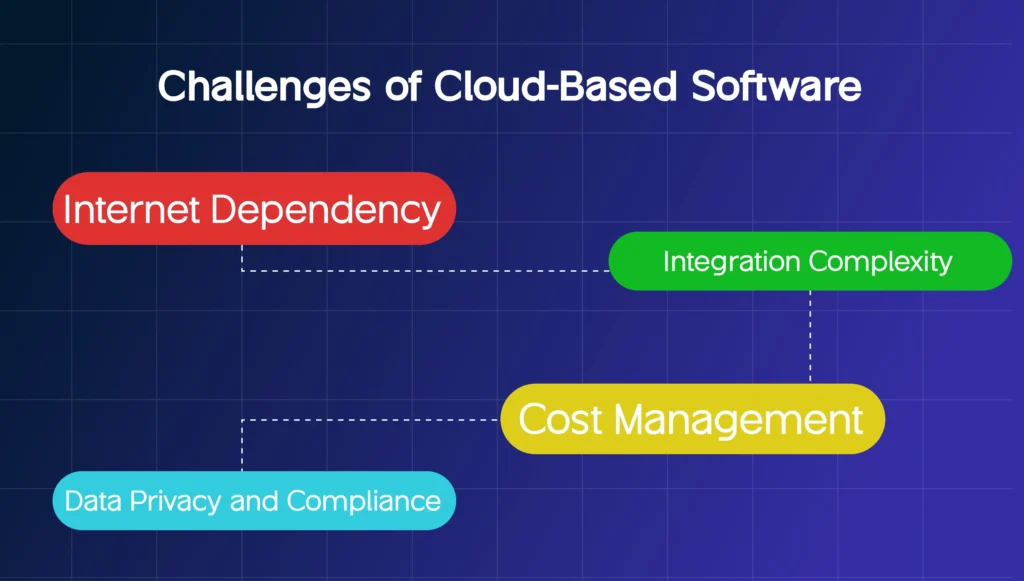
1. Internet Dependency
Cloud-based software depends on the internet since its operation is online, and therefore, a consistent and stable internet connection is necessary. Any failure or poor connection can interfere with the working processes and restrict access to valuable tools.
2. Data Privacy and Compliance
One of the issues of the first order is the security of sensitive information. To achieve data integrity, business enterprises should make sure that their cloud solutions comply with industry regulations, security standards, and requirements under compliance.
3. Integration Complexity
It may be difficult to integrate cloud applications with the existing or legacy systems. It may require proper planning, technical skill, and systematic migration in order to guarantee smooth compatibility.
4. Cost Management
Cloud-based software may help to lower upfront costs, but due to poor monitoring of subscriptions and resource utilization, it may raise monthly costs. Cost control is efficient in assuring sustainable and predictable costs.
Conclusion
The cloud-based software is an essential value of contemporary business. Applying the appropriate cloud solutions, including SaaS, PaaS, and IaaS, and productivity tools, companies will be able to save money, enhance cooperation, and be able to scale efficiently. Best practices will guarantee effective implementation and reduce the risks, and organizations will survive in the digital-first world.
The use of cloud technology can enable business organizations to remain agile, be innovative, and have a competitive advantage in the current market, which is highly dynamic.
Frequently Asked Questions
What is cloud-based software?
Cloud-based software can be defined as applications running on remote servers and accessed through the internet rather than being installed on local computers. This enables businesses to utilize potent tools without having to possess the physical hardware.
Is cloud-based software secure?
Yes. A majority of the trusted cloud service providers provide high-security solutions, including data encryption, access control, multi-factor authentication, and frequent backups to ensure sensitive data protection.
What are the main types of cloud-based software?
The major ones are SaaS (Software as a Service), PaaS (Platform as a Service), and IaaS (Infrastructure as a Service). They are used to meet the various business requirements of businesses, like day-to-day operations, application development, or infrastructure maintenance.
How does cloud software help remote teams?
Cloud applications enable teams that work remotely to access files, work in real time, and communicate without using physical office infrastructure. This helps in flexibility and enhanced productivity in distributed teams.
Does cloud-based software reduce IT costs?
Yes. It does not require costly hardware, physical servers, and big IT departments to manage maintenance. The majority of cloud services are based on subscriptions or pay-as-you-use services, and it is much easier to budget.
Can cloud software integrate with existing tools?
The majority of the cloud tools are made to be integrated with CRM, ERP, marketing tools, accounting tools as well and communication tools. Strategic planning can make the integration proceed without problems.
How can a business choose the right cloud provider?
A business must consider providers according to their security measures, cost, scaling, customer services, guarantee of uptime, and features. The selection of a trustworthy supplier will guarantee the sustainability of performance and the protection of data.

